(Iapheia) A Monstrous Taxonomy
Iapheia overview post here.
The following taxonomy is a modified version of that used in Stanton Ecken's Index of All Creation. Ecken's categories predate the Tribulation War by over a decade, and were highly controversial even at the time, but they're clearly defined and easy to work with compared to the competition. Most serious teratologists, surveyors, and civic defence bodies use this list or a variant of it to classify the threats they face.
Sapients
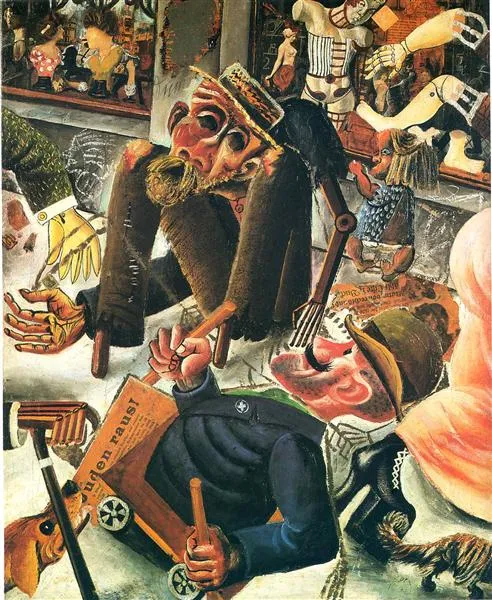
Otto Dix, Pragerstrasse (1923)
Sapients are defined as beings of terrestrial origin with minds capable of complex thought. Humans are the only natural members of this category, and those who wish to distance themselves from Ecken's flirtation with elf theory sometimes rename it accordingly, but anything that was once a human also falls into this group as long as it's still conventionally alive and has no uranic signature.
In the context of the world they now live in, humans are glass cannons. They have access to potent weapons, but their Pain Thresholds are painfully low, even with armour. More elite humans have better to-hit bonuses and fight smarter, but they are just as fragile as their rookie counterparts. Only exceptional humans (such as PCs) have Grit. (This will probably all make sense once the post about the damage system is finished.)
Terragens
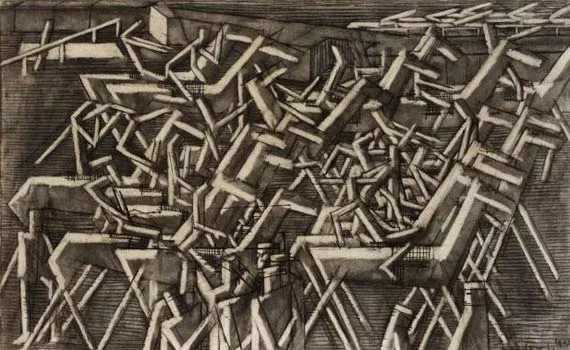
David Bomberg, Racehorses (1913)
This category covers all mundane animals. Iapheia's fauna are broadly similar to our world's, but there are a few notable points of divergence:
- Iapheians keep swine as pets. The cotchen, a smaller, smarter relative of the domestic pig, is ubiquitous. Rural folk train boar-descended rutters as guard animals, and they've seen occasional military use.
- Ogre crabs are bred as livestock, even inland. Crab is a peasant meat, cheaper even than mutton in most places.
- Wolves and wildcats menace the countryside, but marauding gangs of malevolent, man-sized dire goats are what travellers truly fear.
The debate over whether sapients should be considered their own category or a subcategory of terragens has a body count somewhere in the hundreds.
Animals vary wildly in temperament and stats. Big predators can be threatening, with high Pain Thresholds and hard-hitting attacks. Animals never have Grit - they fight, but they haven't developed the ability to make war, to be warriors.
Uranids
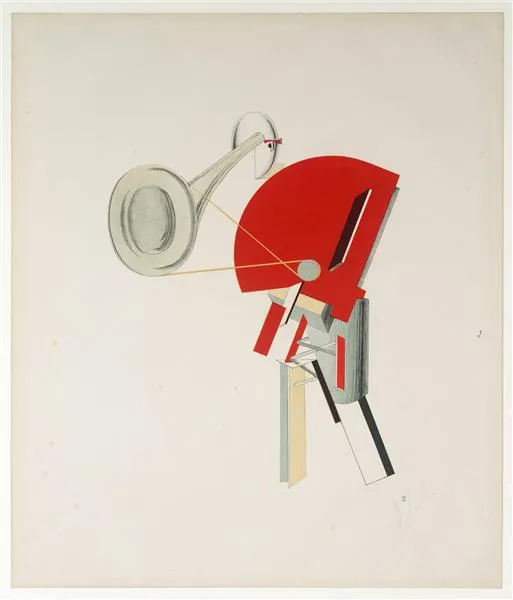
El Lissitzky, Announcer (1923)
The uranic layer is a realm metaphysically separate from the material world we know. It's inhabited by uranids, known less scientifically as angels, bound to the mysterious protocols they were given at Creation. It's said that they often took physical forms and walked among humans in ancient times, but such visitations are vanishingly rare now.
Through certain rituals, angels can be drawn through rifts between the uranic and material layers, and forced to manifest in the world of humans. Once called and bound, they can be reprogrammed. Human binders' grasp of ediction, the process of instructing an angel's brain, is painfully rudimentary by cosmic standards, but it's sufficient to make angels obey coded commands and follow certain pre-programmed routines.
Angel-binding has been practiced by dangerous eccentrics and hubristic scientists since time immemorial, but industrial advances over the last century have made the binding and ediction process much cheaper, safer, and less reliant on personal finesse. The Tribulation War was the first truly "angelised" war, with both sides employing angels en masse in both combat and support roles.
Physically manifested uranids have a wide range of unsettling forms, from random clusters of colours and shapes to guises that appear somehow more human than humans. They cannot speak or understand terrestrial language, and vice-versa; human-angel communication must be visual or through tones and vibrations. They register as a distinct, strained presence amid the swirling chaos of the uranic layer, which can be picked up with specialised instruments.
Angels are, by pre-war standards, near-apocalyptic threats. Trying to bring one down with small arms is generally suicidal: they hit extremely hard, are immune to all psychological and metabolic hazards, and can take multiple serious wounds to bring down, potentially changing form as they take more damage. They are, however, bound by their imprinted commands to at least some degree (though ediction does decay with age). Angels lack the free will necessary to possess Grit.
Metauranids
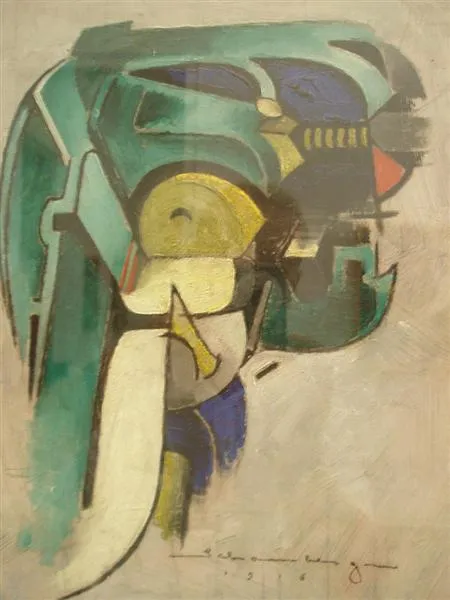
Morton Schamberg, Painting IV (Mechanical Abstraction) (1916)
"Artificial angels" is technically an oxymoron, but it's far easier than trying to decipher than Ecken's famously dense definition of the metauranid. They are terrestrial entities grafted together with uranic elements, typically the butchered components of angels. The terrestrial component is usually a specially prepared mechanical frame, a puppet to be operated by the angelic remnant. The latter half of the Tribulation War saw both sides experimenting with animal-uranid and even human-uranid grafts, but these proved non-viable in the long run, as ediction has unpredictable warping effects on conventional thought and volition.
Most angel engines and nephilim, to use their common names, aren't as hardy as angels, but they're still resilient and share the same immunities. They're among the most unpredictable of foes, but, for those who can figure them out, tricking or bargaining with them is surprisingly possible. Unlike pure angels, metauranids have free (albeit deeply skewed) wills, and can and frequently do have Grit.
Athanatids
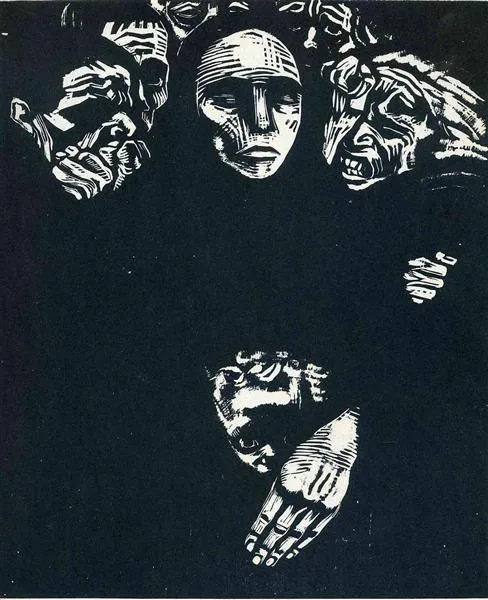
Kathe Kollwitz, The People (1922)
Nobody calls them that in practice. Undead. They're undead. Solid undead, more specifically, corpses revived or preserved through death by supernatural means.
The undead most folk recognise are mindless, reanimated shells. They were once quite rare, scientific curiosities with little practical value, but the Tribulation War brought both a need for innovation and a bottomless supply of bodies. Undead soldiers are slow, stupid, and incompetent, but they can stand in a spot and take a few hits, and that's better than nothing. They were raised en masse in the desperate last days of the war, sent to occupy every hill and hamlet within reach, and, when the ceasefire came, abandoned where they stood. Most collapsed after a few months without orders or maintenance. Some went rogue, feeding on ambient uranic radiation or the sputtering husks of war engines.
There is another class of athanatids, though. Clever, amoral, boundlessly hungry. They've been around since humankind was young. They burrowed deep into the earth and endured the Tribulation War just as they'd endured every crisis before it. To them, the chaos of post-war Iapheia is a buffet of opportunities, and, one by one, quietly, they are emerging to feast.
Undead ignore lesser wounds but are instantly destroyed by serious ones. They're immune to anything that specifically affects a living body, which encompasses a lot. Common, mindless undead never have Grit. Intelligent undead are rare, and do possess Grit, often a lot of it; their immortal conviction is all that's left of their long-forgotten living selves.
Cognids
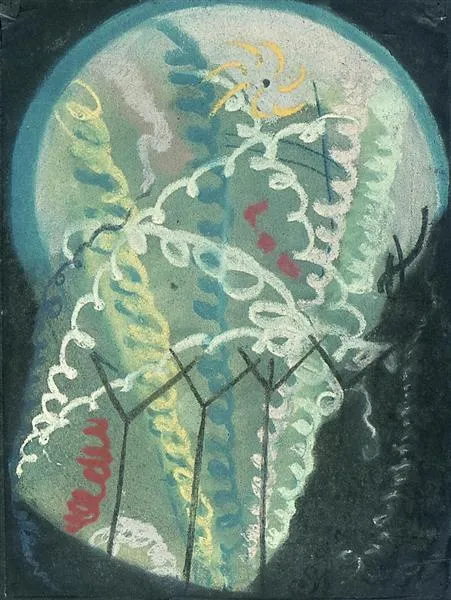
Theo van Doesburg, Composition (1931)
This one's controversial. Some editions of the Index of All Creation leave it out on the grounds of taste or questionable science. Cognids' existence is impossible to prove with current science, and those who know most about them are disinclined to share.
They're real, though. And, while they were widely derided as a novel flight of fancy on Ecken's part, cognids have been known in Iapheia for hundreds, perhaps thousands of years, under a different name: demons.
Cognids have no measurable presence on the material or uranic layers of reality. They are pure thought-beings. They cannot compel or dominate, only suggest and inform - and there are few better informers. They skim the minds of those around them freely and feed juicy morsels selectively to their favoured hosts, always nudging them, it seems, towards chaos, death, and ruin.
Cognids, or demons, or whatever you call them, have no game stats. Fighting them conventionally is impossible. Their hosts, of course, are just as mortal as any human.
Those Beyond
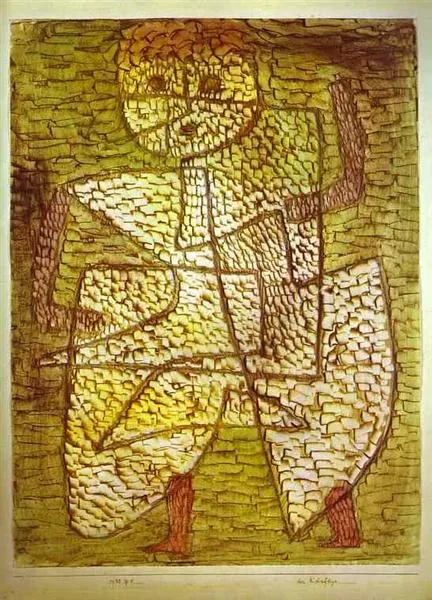
Paul Klee, The Future Man (1933)
The Index of All Creation does not acknowledge or classify ghosts. Iapheia was amply haunted even before the Tribulation War, and the psychic and metaphysical chaos of its battlefields are thought to have attracted many more restless souls to the realm of the living. It's probably just uranic phenomena and confirmation bias, though.
There is also the awkward matter of thinking machines. Some engineers have proposed the possibility of purely mechanical intelligence, with no help from bound angel components or human operators. This is a pure hypothetical for now... except, there's a popular rumour that an eccentric minor aristocrat somewhere in the Iapheian Main built a machine that could think, just before the Tribulation War, and that her creation somehow survived the violence. There's no evidence of this, of course, bar a few scattered reports by shaky soldiers who'd read too many sphere fiction magazines.
Aside
The classification of monsters in TTRPGs is one of those areas where my personal, visceral preferences clash with my cerebral sense of what's good and tasteful.
I love sorting. I've been sorting my whole life. My day job is like 30% sorting and that 30% is my favourite part of it. Maybe it's because I grew up on 3.5 with its rigidly prescriptive list of monster types and subtypes, but the urge to classify and segment any given RPG bestiary is overwhelming.
That urge butts up against a standard medieval fantasy milieu. This isn't to say that taxonomies and hierarchies are alien to the medieval-ish world, but "not quite one thing, not quite another" is one of the classic monstrous traits. Monsters sprawl across the boxes you try in vain to draw around them, or just linger at the edges refusing to be sucked in.
This isn't medieval fantasy, though. Iapheia is modern, and the 19th and 20th centuries were huge for fans of categorising things, whether (Dewey, Mendeleev) or not (Gobineau, Strauss-Howe) it made sense. When a medieval peasant encounters a monster, the last thing on his mind is working out its precise place in the cosmos. But when a Iapheian ranger encounters a monster, someone somewhere probably has to fill in a form about it, and put an X in the appropriate box. The categories are still flawed and incomplete, obviously, but their existence and use feels much more harmonious with the setting.