(GLÅUGUST) Breath of the Gods
GLÅUGUST challenge 5, prompt 5: a capsule game.
This is a narrative duelling game, though it should work with any number of players. It owes much to the highly entertaining blogpostgame SHIZZARDS, but is a bit more structured.
I have not yet playtested this game. Numbers and mechanics are liable to be tweaked without warning.
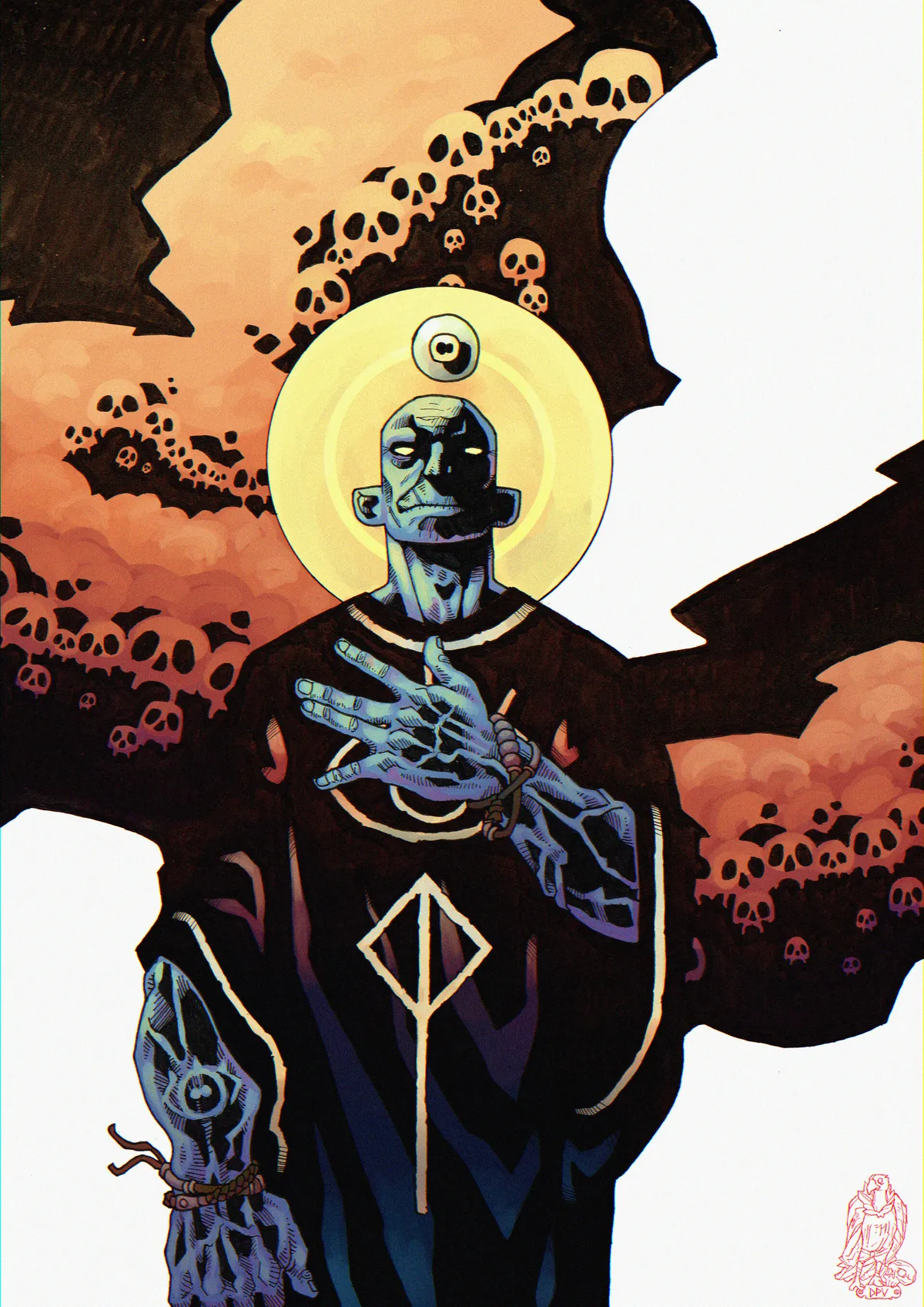
Domenico Pisano, ARCHMAGE (2022)
Setup
You and your fellow players are wizards. Serious wizards, subtle and quick to anger, the kind with several worrying epithets and a flamboyant outfit. You have come together to settle a cosmic dilemma, centuries-old grudge, or petty academic slapfight, through unthinkable supernatural violence.
Each player will need a reduced deck of standard playing cards: A-5 plus the face cards in all four suits, for a total of 32 cards. Each player will also need some scratch paper for a character sheet, index cards or sticky notes for lasting effects, and the group should have a token to mark the edge and a shared initiative tracker of some sort, with a way for players to mark their own initiative counts. A simple number line with tokens will do, or percentile dice, or those life spinners people use for TCGs.
At the beginning of the fight, each player should determine their wizard's two themes by rolling twice on their favourite random table of magical themes. Then everyone names and describes their wizard, and agrees on a location for the duel.
(If you somehow don't already have a favourite random table of magical themes, I have provided a pretty basic one here.)
Second, each player should write out the card ranks A-5 on their character sheet, and assign one of the following spells to each. Duplicates are allowed. Alternatively, roll 1d10 five times to generate your spells.
- BANE (debuff an opponent)
- BLAST (multi-target direct damage)
- CHARGE (empower your next spell)
- COMMAND (control something directly)
- CONJURE (summon a creature to fight for you)
- ENCHANT (place a lingering magical effect on something other than you or an opponent)
- GAMBIT (distort or meddle with an upcoming spell)
- MANIFEST (create a field hazard or other object)
- WARD (create a shield against a direct damage spell)
- WRACK (single-target direct damage)
Spell descriptions are at the end of the post.
Also, as a reminder, mark the following:
J: PAUSE 1
Q: PAUSE 3
K: PAUSE 5
Remember that PAUSEs are not spells.
Each player should then shuffle their deck and draw seven cards. Each wizard begins with 20 LIFE (as is tradition) and 7 BREATH. Randomly choose one wizard to begin with the edge.

Erick Altensleben, Tähti - Travelling Wizard (2021)
Playing the Game
A wizard duel has a distinct rhythm: flurries of world-shattering power punctuated by long, dreadful silences. A duel is divided into exchanges, each consisting of three phases: Planning, Casting, and Recovery.
1. Planning Phase
Starting with the player who has the edge, each player may choose to play a card from their hand face down into their stack, or pass. You can choose to play more cards even if you've passed before, if you wish.
The Planning Phase ends when everyone has passed in sequence.
2. Casting Phase
Set the time tracker to 0. The player with the fewest cards in their stack gains the edge; break ties to the left of whoever currently has it.
Each player flips their stack face up and sets their initiative to the rank of the top card. (Aces and Jacks count as 1, Queens as 3, Kings as 5.) That top card is their active card.
Count the time tracker upward, one tick at a time. When it reaches someone's initiative, that player's active card resolves. The player with the edge wins ties, and further ties are broken to their left.
If your active card is a spell, you can spend BREATH equal to its rank (again, Aces are 1s). If you do, you cast it and resolve its effects. If you can't or won't pay, the spell is discarded without effect and the magical backlash deals you 1 damage, which cannot be mitigated in any way. If it's a PAUSE, you gain BREATH equal to its rank, to a maximum of 7.
Once you've resolved a card, discard it and reveal the next card in the stack. Increase your initiative by its rank. So if your initiative was 3 and your next card is a 2, your new initiative is 5.
If there are any more cards to resolve on the current time tracker count, do so; otherwise, keep ticking it up.
When you take damage while your active card is a spell (not a PAUSE), you may spend 1 BREATH. If you can't or won't, you are stunned - turn your stack sideways to indicate it. Your current spell will have no effect when it resolves. Simply discard it, then you recover. (You don't suffer magical backlash for this.)
The Casting Phase ends when all players' stacks are depleted, or when all remaining stacks show PAUSEs. Any leftover cards are discarded.
3. Recovery Phase
Reset the time tracker and all initiative counts. Everyone refreshes their BREATH back to 7.
Players with 0 LIFE are eliminated. (Yes, they stay active until this point.)
Starting with the player who has the edge, each player may discard any number of cards, then they draw back up to seven. Any player who doesn't have enough cards to refill their hand is eliminated.
If only one player remains, they win. If everyone has been eliminated, they all lose. In any case, the world at large is probably worse off.
If there are two or more players still in the game, take a breath, then return to the Planning Phase.
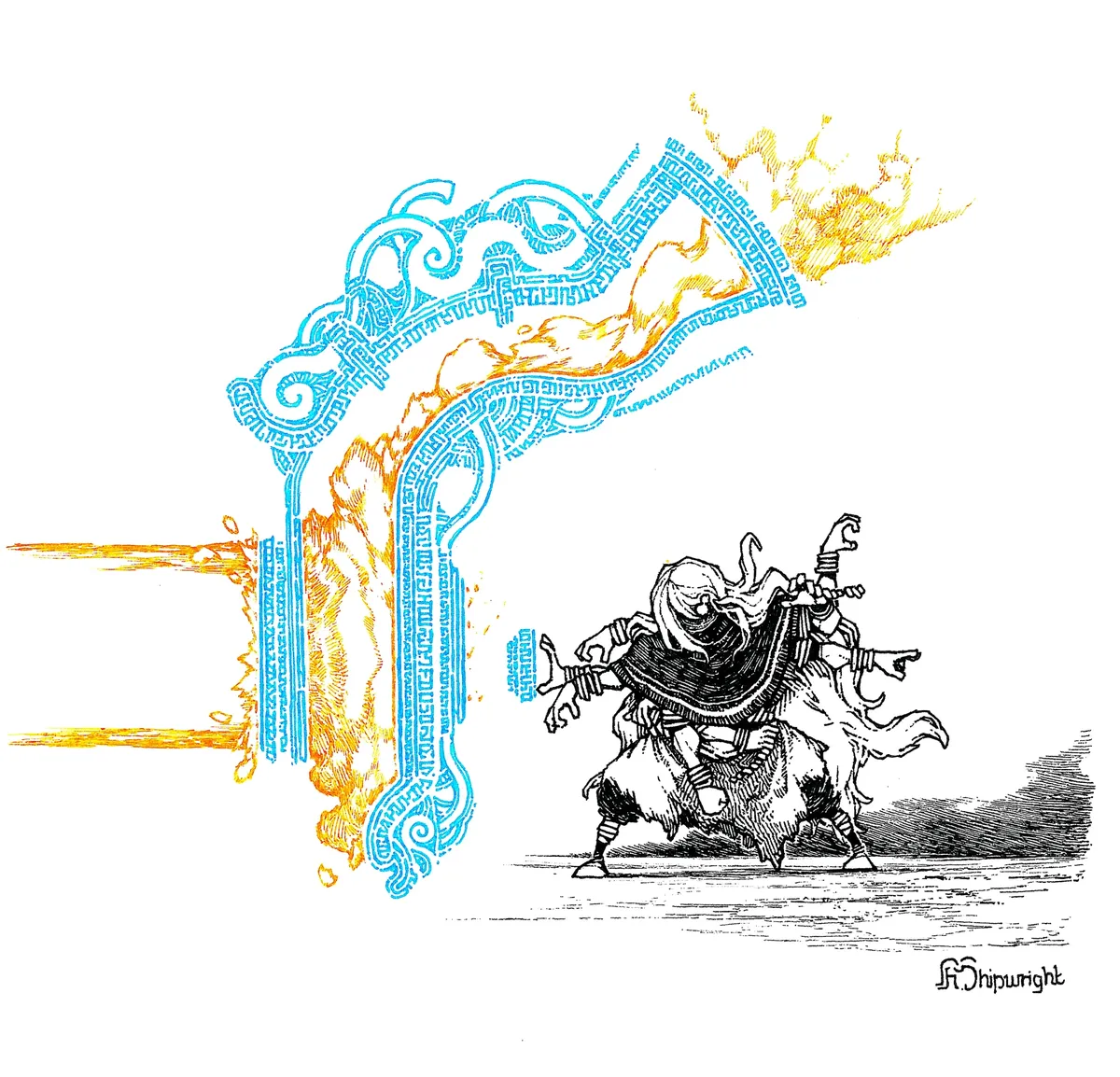
A. Shipwright, Magic Circuit (2026)
Spells
General Guidelines
- Spells are always influenced and limited by the caster's themes. A wizard of Fire and Corpses will have a very different BLAST from a wizard of Stars and Sickness. Always describe your spell's effects in narrative terms as well as hard numbers.
- Each spell's approximate power level is determined by its rank, shown as [R] below. As a general rule, a spell can only counter or destroy another spell if it matches or beats that spell's rank.
- If a spell creates something [lasting], it should be represented with an index card or sticky note, with a brief description of the thing and its rank.
- Targets are not chosen until the spell resolves. Any beneficial spell that affects you can be donated to another wizard, with their consent.
- Creativity is encouraged. Many situations will require some arbitration and guesswork. Be prudent with your own interpretations and generous with your opponents'.
Spell Descriptions
BANE
swirling electricity, spectral laughter, tonguetwister hex
Place a [lasting] debuff on another wizard. Their spells cost 1 BREATH extra to cast. BANE overlaps but doesn't stack with other BANEs.
A wizard can remove a BANE on them by spending [R] BREATH at the end of the Casting Phase, just before the Recovery Phase begins.
BLAST
fireball, scourging darkness, swarm of skeletal hands
Deal [R] damage divided as you choose among any number of wizards and/or other targets.
CHARGE
tap a leyline, sacrifice thralls, snort powdered demonbone
Your next spell's effective rank is increased by [R] without increasing its casting time. You lose this buff if you're stunned, or if you suffer backlash from not casting a prepared spell.
COMMAND
dominate monster, fling scenery around, tear the earth asunder
Manipulate a [lasting] effect (any effect, not just your own!) or some other element of the location as established. This might act as a BLAST, WARD, CONJURE, or GAMBIT of equivalent [R], depending on the target and nature of the COMMAND, or it might dispel or destroy the effect if [R] is high enough.
CONJURE
betentacled horror, elemental, undead legion
Summon a [lasting] creature to serve you. It has [R] LIFE.
At the end of the Casting Phase, if a CONJUREd creature is alive, it gets an action equivalent to a rank [R] spell. Usually this will just be a BLAST, but other effects may be possible depending on the creature's nature. Higher [R] creatures tend to be more versatile.
ENCHANT
strength of a hundred, pacifying curse, electrify the water
Create a [lasting] effect attached to any other [lasting] effect in play. This will usually create some new narrative options based on the nature of the ENCHANT. An ENCHANT may add its [R] to the subject's [R] where it's obviously beneficial, or subtract its [R] where it's obviously harmful.
GAMBIT
twisted visions, well-placed portal, sigil trap
When you resolve a GAMBIT, attach it to another wizard's active spell or a [lasting] effect of equal or lower [R]. If you choose an active spell, that wizard can no longer choose not to cast the spell if they can afford it.
When the spell resolves or when the [lasting] effect would do something significant (like a CONJUREd creature attacking or a MANIFESTed effect being subject to a COMMAND), the owner of the effect describes it as normal, and then you can adjust one key detail of your choice. You can't completely nullify an effect or turn it directly back on its caster, but almost anything else goes. Once this is done, discard the GAMBIT.
MANIFEST
rock to mud, call down a rainstorm, gateway to the Dimension of Slime
Create a [lasting] object, environmental effect, or amount of a substance appropriate to your theme. Most MANIFESTs don't do anything on their own, but they can fuel COMMANDs, ENCHANTs, and GAMBITs, and offer new tactical possibilities for other spells. If it makes sense, a MANIFEST might be able to dispel or nullify another [lasting] effect, but this will usually destroy both of them.
WARD
angelic shield, wall of sharp stones, illusory duplicates
Create a [lasting] barrier attached to you. A WARD can be sacrificed to negate, dispel, or counter any hostile spell of rank [R] or less affecting you or one of your [lasting] effects - the only exception is that WARDs cannot protect other WARDs. This includes destroying harmful ENCHANTs or similar effects that have already been cast. Multiple WARDs can be cashed in at once for a higher effective [R].
WRACK
phantasmal killer, wasting curse, just smash their fucking head in
Deal [R] damage to a single target. WRACK counts as having double [R] for the purpose of defending against it, and its target must spend 2 BREATH to avoid being stunned by it, not 1.