(GLÅUGUST) The Divine Hum
GLÅUGUST challenge 4, prompt 1: non-Lovecraftian cosmic horror.
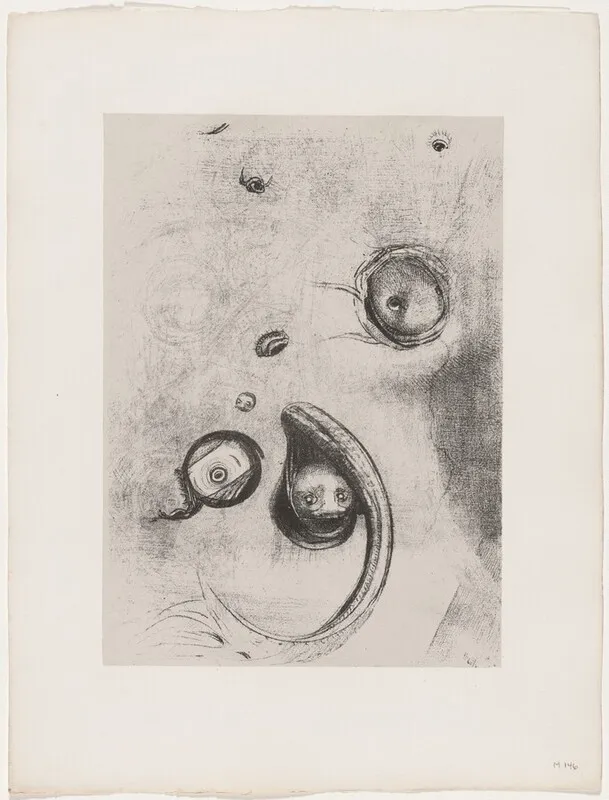
Odilon Redon and Georges Aubert, ... Et Que Des Vuex Sans Tête Flottaient Comme Des Mollusques (illustration from Gustave Flaubert's La Tentation de Saint Antoine, 1874)
In the beginning, there was the Word. Or a thunderous eruption from the formless earth. Or an immaculate primal song. Or the clangour of a divine anvil, or the grunts and groans of a father-god, or just a very, very big bang. Whoever you believe, creation made a noise, and that noise had an echo, and that echo is the Divine Hum.
The Hum is a low, constant thing, ever resonating and reduplicating across the cosmos. You can't hear or feel it, because your ears and bones and brain have evolved to filter it out as background noise, and nor can almost anyone or anything else. You might hear the Hum if:
- You spend a lot of time at high altitudes.
- You have natural perfect pitch.
- You have one of a few rare endocrine conditions.
- You come close to dying by suffocation.
- You have a specially prepared brass spike hammered into the base of your skull.
Once you've tuned into the Hum once, it'll always be there. It's like becoming aware of your breathing or your tongue - it comes and it goes, it'll wear off after a few minutes if you're adequately distracted, but it can come back in an instant if you think about it again. It's not painful or particularly pleasant, but it is dominant. When the Hum's in your head, it's hard to think of much else. It's surprisingly addictive, if that "much else" worries you more than it soothes you.
No process can discern for sure whether someone can or cannot hear the Hum. Mind-reading spells can identify when someone thinks they hear it, which is a very different question.
Scholars of the Hum (there aren't many, for reasons that will soon become clear) often imagine it as an aloof, apathetic thing, a higher phenomenon whose impact on mortals is wholly coincidental. That's one possible reading. By another reading, the reading most common among its devotees, the Hum adores every being in creation as dear siblings, and laments that they have lost touch with it. For that, it blames entropy. Inconstancy. Progress. If the world could only stand still and breathe, it would hear the Hum again, and all would be as it was in the beginning.
The Hum is not articulate enough, and possibly not sentient enough, to command those who hear it. It's vaguer than that. If they act against its will, it fades to whining, irritating tinnitus. If they act in its favour, it soars to an exuberant, all-consuming drone, the oblivion it grants growing deeper and more comforting. Scientists might call it classical conditioning, if any serious scientists believed in the Hum. And once one person's gotten the message, they can spread it far more easily.
In no particular order, the Divine Hum hates:
- War.
- Instrumental music.
- Writing, especially histories.
- Any technology more complex than a mill.
- Sex.
- Terraforming.
- Art that depicts anything concrete and recognisable.
- Most religious authorities. It's okay with very small, grassroots-y movements, and does not seem to consider its own followers a religion.
It loves:
- Agriculture.
- Choral singing.
- The absolute wanton destruction of anything it hates. It loves this much more than it hates war.
Some of the above may be an extrapolation or an outright lie by some of the Hum's adherents. They don't keep written records, and curiosity about their history or development is rarely indulged, so it's almost impossible to tell.
Unless, of course, you find a way to tune into the Hum yourself, and start testing it out.