(Iapheia) Antitech
Technology is probably the single most popular scapegoat for the Tribulation War, beating out complacency, territorial greed, the "death of sound reason", Noskan or Kheshi interference, public immorality, aristocratic inbreeding, women, the primacy of treaties over genuine cordiality, and any number of evil shadow councils of war profiteers from various convenient ethnicities.
It's not entirely unfounded. The war certainly couldn't have reached the heights it did without huge advances in both uranic and terrestrial science in the preceding decades. But, once you've accepted that technology was a cause, the idea that it might have been the prime or only cause becomes rather alluring. A simple evil with a simple cure.
What's the cure? Well, it depends on who you ask.
Gnosmatics
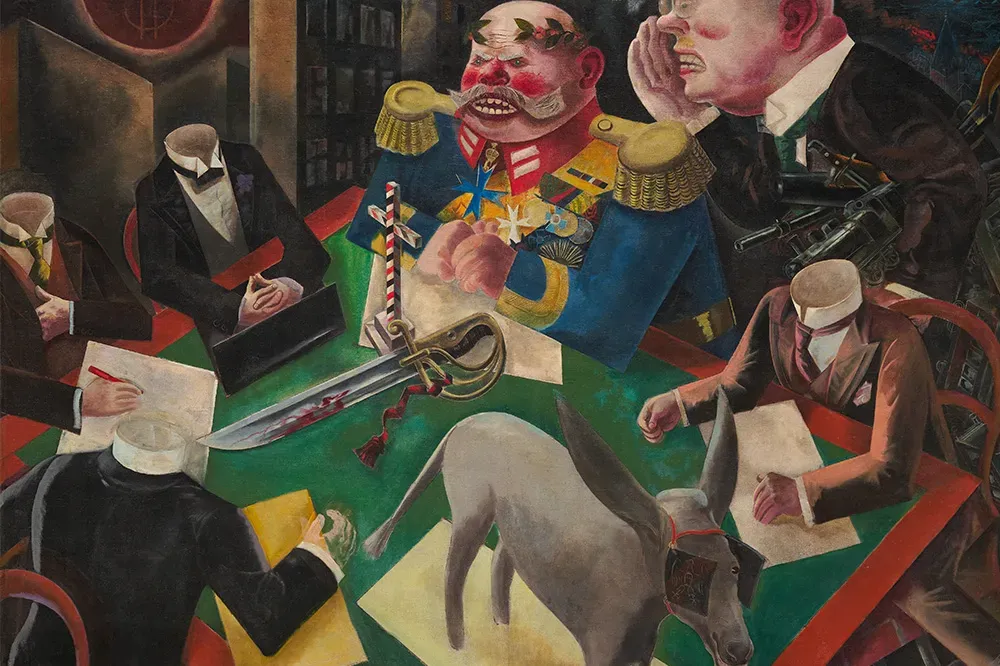
George Grosz, Sonnenfinsternis (1926)
Gnosmaticism as a political movement predates the Tribulation War by decades. North Obern had a Gnosmatic Party as early as 1014, though it was a much-mocked electoral failure. The core belief of Gnosmaticism is that humankind has already discovered everything it needs to be happy and prosperous. They tend to put the date of "completion" sometime around the year 900, and anything invented after that point is derided as an extravagant waste of resources and possibly a danger to public morals. Conservative developments of existing technologies are fine, but there's no consensus on where exactly to draw the line between iteration and creation, and, when the stakes are as high as Gnosmatics believe they are, surely it's better to err on the side of caution.
Fully-fledged Gnosmatic political parties are rare, but there's a "Gnossie" tendency in almost every party with a socially conservative bent. They are outwardly a pretty dry1 faction, and even their allies stereotype them as rambling bores, albeit reliable ones. This is not an inaccurate description, but, beneath their stuffy exteriors, Gnosmatics play dirty.
Most Gnosmatics are scions of old-money families. Not the princes and Grand Dukes of the world, but the gentry, the petty local magnates, the ones whose antics filled out the back pages of the society papers. They grew up on a clear narrative: the march of industry was eroding their power, and they would grow up poorer and less relevant than their fathers. The war was just a violent acceleration of that arc. They're still richer than most people, but burnt by a profound sense of loss, and, in the chaos of the post-war Main, they will do almost anything to drag themselves back to their rightful place in the hierarchy.
Their tools are the tools of old-school politics, before it earned its respectable modern veneer. They insinuate. They threaten. They break windows and limbs with the same bored efficiency. They never do it themselves, of course, heavens no. How unbecoming. Beneath every Gnosmatic senator or district mayor are half a dozen deniable lackeys, retainers, and "able friends", tight-lipped and heavy-handed. The Gnossies' allies crack jokes about these heavies, but they'd better not laugh too loudly if they know what's good for them.
White Hounds
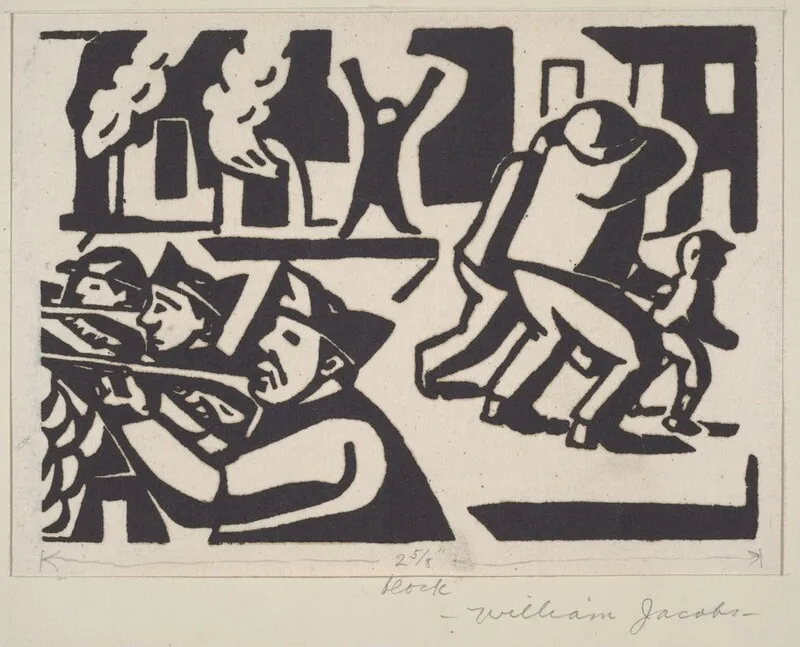
William Jacobs, Untitled (1938)
The White Hounds are urban antitech insurgents. They're one of the more successful and widespread militia movements, with a presence in pretty much every city, though their prominence ranges from "serious political force, too strong and numerous to police" to "three men arguing in the back room of a coffee house". They take their name from a popular neo-fable about a hubristic doctor whose favourite test subject, a white hound, breaks loose in a vengeful frenzy after one experiment too many and tears out his throat. Their traditional colours are white (or at least off-white) and red.
Plenty of militias are at least antitech-curious, but the White Hounds make the crusade against technology their primary purpose. The field of uranics is their nemesis, of course, but few cities have any major uranic resources left and angel-hunting is dangerous and scary, so the White Hounds tend to set their sights on lesser, more reachable marks. Factories, public transit, and radio towers are common targets, but pretty much anything from electricity onwards is fair game, and some extend their hit list to social technologies like newspapers or civil services. (Never mind that both of these things have been around for centuries. White Hounds are not known for their education.)
Their main pastime is simple sabotage, with a side of robbery where possible. The bigger, more sophisticated packs (yes, they call their local divisions packs) experiment with extortion, shaking down citizens for a "deviance tax" to absolve them of their complicity with the evils of tech. They're not very good at this, but it works often enough to be worth it. Smaller packs get by on petty theft and, where possible, holding down normal jobs.
Successful White Hound packs can find work as heavies for sympathetic political parties (conservatives, mostly, plus some of the more fundie communists2), but they're best kept at arm's length. They bore easily, and have a bad habit of starting unnecessary fights with rival militias or law enforcement.
The White Hounds are rarely a long-lived force, and they seldom get what they want, even when they can agree on what exactly that is. But, when they do fail, they can do plenty of damage on their way down.
Retrogonists
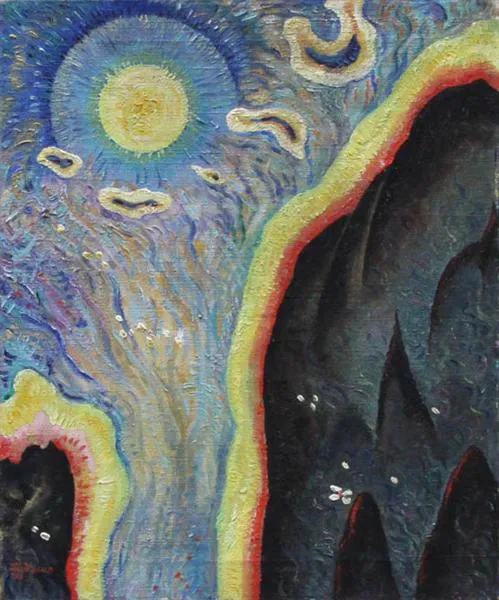
Jock Macdonald, Day Break (1936)
Mabradesc psychiatrists describe retrogony as a culture-bound syndrome unique to the Iapheian Main, an "anomic severance" brought on by the unique traumas of modernity in general and the Tribulation War in particular. Mabradesc psychiatrists also describe anti-nationalism, cat ownership, and enjoying rag music as potential anomic severances, so take that with a grain of salt. Whatever the cause, every so often - more often than anyone would like - a perfectly lucid fellow will abandon their life and possessions and stagger off into the wild, howling with primordial rage. With a little luck, they find their kin, and become a fully fledged Retrogonist.
Where Gnosmatics seek to curb modern science and White Hounds make war against it, Retrogonists, or "Rets", forsake it entirely. Anything more complex than a plough is a hateful abomination. Wheels, fire, and even language are on shaky ground. The idealised past they seek to inhabit is rather a skewed one, violent and lawless even beyond the high baseline of real history. They imagine themselves as tool-using animals struggling against a world that despises them. From a certain angle, they're sort of right.
A Retrogonist colony as imagined by a non-Ret is a ramshackle fort in the countryside, full of flea-ridden, bloody-minded wretches with sharp rocks on sticks and a sinister knack for stealth. A few such boltholes do exist, but most Rets are actually found much closer to home. Many cities have a ruined, mostly-abandoned district which has become the "Ret quarter", a concrete wilderness where Retrogonists lair in crumbling tenement blocks and live off rainwater, vermin, and poorly maintained vegetable gardens.
Fewer people "go Ret" every year, and they die from disease, malnutrition, and thoughtless territorial violence faster than they're replaced. If anyone was tracking it seriously, they'd project a practical end to the phenomenon within a decade. Of course, that means the Retrogonists still around now are the hardiest and smartest of the lot.
"Dry" is the Iapheian word for the kind of politics where you give speeches and put up posters, as opposed to the "wet" kind where you blackmail people and blow things up.↩
Many Iapheian communists, most prominently the Empiric faction, argue that communism is the natural state of human society, deliberately suppressed and alienated for thousands of years. They are essentially traditionalists, except that (if you believe the black-tongued lies of those munesc dogs) their traditions have never quite existed.↩