(Iapheia) Communications in Iapheia
The Tribulation War was to the physical sciences what the post-war era is to society: a constant runaway explosion of creation and iteration. Its products were numberless, bizarre, and often very short-lived. Thousands upon thousands of inventions died in testing or were obsoleted before they'd come to fruition, but the churn never slowed down. Until the desperate final years, military R&D budgets were functionally unlimited and unsupervised, with the increasingly flimsy justification that the products of all this frenzied discovery would one day benefit civilians too.
That hasn't happened, obviously. Even in the Powers, turning the few technologies that proved their worth to peaceful ends is a long way down the agenda. But, when the people of the Iapheian Main grumble and commiserate about this, and a hundred more broken promises from dead governments, they can do it more easily and over greater distances than ever before.
Radio

Fernand Leger, The Singer on the Radio (date unknown)
Longwave radio has been around for decades, but pre-war transmitters and receivers were expensive and power-hungry. It was the domain of rich eccentrics and a few forward-thinking governments, and used solely for point-to-point communication; public radio was nonexistent. The shortwave technology developed during the Tribulation War is cheaper, somewhat more portable, and, vitally, hardened against the uranic disturbances that destroy longwave signals.
Today, all surviving cities have multiple radio stations competing for time, airspace, and attention. Some of these are government-run, carrying heavily edited news and inoffensive light entertainment; their frequency band will be reserved, and intruding on it is a serious crime. But anyone who can acquire, power, and defend a transmitter unit (military-surplus or homemade) can start a radio station, and it's become a sort of prestige marker, a sign that you and your mates should be Taken Seriously. All political parties, most large-scale businesses, and even many gangs and militias operate their own channels, and broadcast whatever they think they can get away with.
Public radio programming is an eclectic mix of recorded and live music, plays and serials of variable quality, advertising, and factual programming. Even very radical groups will program for general appeal as well as their own agendas, hoping to draw in new followers. Communist and Shepherd stations are good places to catch interesting dramas, the Narellondes and Extranationals tend to have the best music tastes, and the Futurist newscasts are by far the funniest.
Peer-to-peer radio is the domain of law enforcement, paramilitaries, hobbyists, and, of course, adventurers. The smallest available two-way sets are the size of a large backpack and extremely power-hungry, but the benefits are well worth the fuss. Conflicts between radio-savvy groups quickly become electronic arms races, with each side's "wizards" (a well-earned Iapheian nickname for radio technicians) striving to intercept and jam the other side's signals with ever-evolving arsenals of extremely illegal jury-rigged tools.
RADIO RECEIVER 20Ł
Lunchbox-sized (1 slot). Requires either mains power or 10 minutes a day of winding, depending on the model.
PERSONAL TRANSMITTER 150Ł
Backpack-sized (4 slots). 3-mile range. Charges off mains, lasts for 6 hours of use. Can be overclocked to boost range to 6 miles, but power consumption is tripled.
SEMI-PORTABLE TRANSMITTER 1,000Ł
Wardrobe-sized. 6ish-mile range (1 overland hex). Requires mains power plus a separate generator (not included).
SHORTWAVE RADIO TOWER probably not for sale
Radio-tower-sized. 18ish-mile range (3 overland hexes). Requires its own dedicated power grid.
INTERCITY RADIO LINK probably not for sale
Radio-tower-sized. Functionally infinite range, but can only communicate with a matched transmitter elsewhere. In permissive cities, private citizens and businesses can rent radio time to talk to distant contacts, for 1Ł per minute.
Telegraph
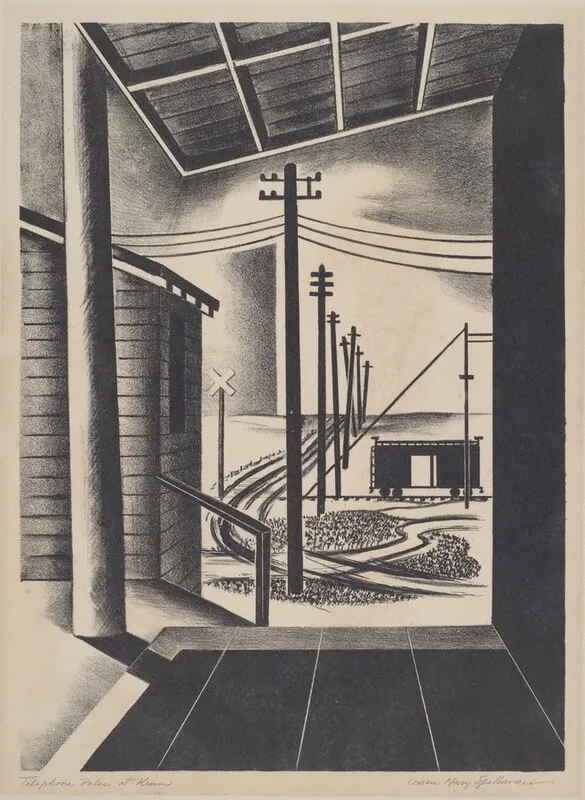
Coreen Mary Spellman, Telephone Poles at Krum (1935)
The long-distance telegraph lines of old lie in ruins, and it's generally agreed that restoring them would be a fool's errand: they'd only be chewed up by dire goats or scavenged for copper by enterprising bandits. For intercity communication, however, the telegraph is cheaper than radio, and more friendly to existing infrastructure.
Telegraph inputs are still done manually by perpetually overworked operators, known as "tellies", in smoky branch offices, but outputs are now handled by cheap receive-only teleprinters - they were massively overproduced for the military and plenty are still in good working order. More affluent (by Main standards) neighbourhoods have one printer per household; poorer neighbourhoods might have one per street or tenement block. Private senders are charged by the letter, so messages are highly abbreviated, and frequent contacts tend to develop their own shorthand familects over time.
Governments can, of course, commandeer the whole network to send out urgent bulletins. All governments would like to monitor and censor the telegraph network too, but only some actually manage it; tellies are surprisingly honest, and cable taps are full of valuable circuitry and invariably stolen within a week of installation. Still, if you're saying something you don't want the powers-that-be to hear, it's best to keep it off the printers.
TELEPRINTER 50Ł
Typewriter-sized (2 slots). Requires mains power and a telegraph connection. Most Iapheian accommodation includes use (possibly shared) of a teleprinter at no extra charge.
TELEPRINT MESSAGE 0.01Ł per character
Yes, spaces count.
Post
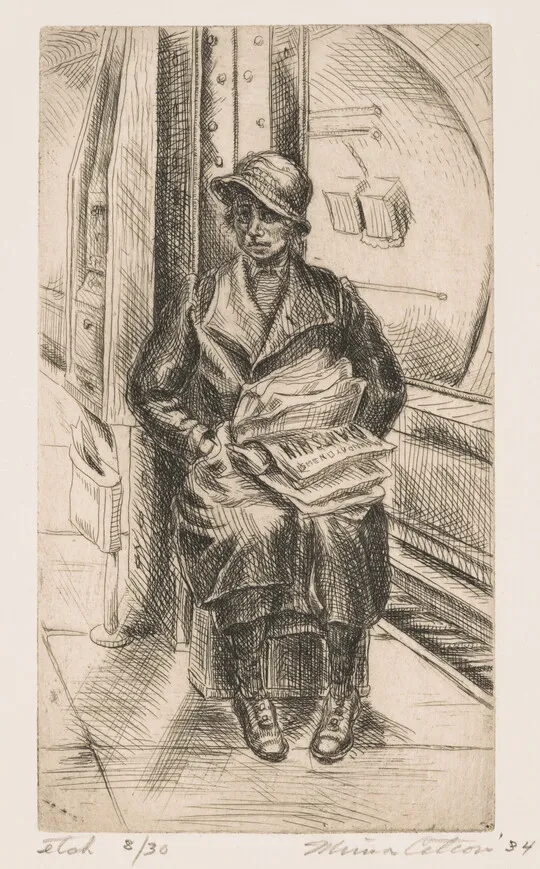
Minna Citron, An Honest Living (1934)
The Iapheian Main's public postal services, already the butt of many a cheap joke, are on the verge of extinction. Squeezed out by telegraphy and private courier services, many cities only have a single decrepit central post office left. The postal service is a classic place to dump undesirable civil servants who'd be too expensive to sack and too much work to assassinate. It's also mostly beneath notice, and has thus been coopted by criminals and radicals as a cheap, if unreliable, way to send messages and conceal hot goods for a while.
URBAN POST 0.20Ł for a letter, 0.50Ł per slot for a parcel
Arrives in 1d6 days, plus 1d6 for each local crisis. 6s explode. On any double, the package is lost, stolen, or destroyed.
URBAN COURIER SERVICE 5Ł for up to 5 slots' worth of stuff
Arrives in 1 day, maximum. Anything obviously valuable has a 1-in-6 chance of being stolen.
INTERCITY COURIER SERVICE negotiable
You're adventurers. Isn't this sort of thing your job?
Other Technologies

Nina Osipovna Kogan, Suprematist Composition (1921)
Semaphore: Sure, it's slow, short-ranged, and offers no privacy at all, but old-fashioned flag-based semaphore has the advantages of being extremely cheap and impervious to power grid disruptions. Training as an emergency volunteer semaphore operator is a favoured pastime of Concerned Citizens across the Main.
Balloon Semaphore: Semaphore, but in hot-air balloons, with special enlarged flag arrays and spyglasses. Satellite villages and farmsteads with no electrical grid may be issued a balloon or two to communicate with the city.
Small Ad: Smaller, more fringe newspapers and radio stations will run advertisements for basically anyone who'll pay. The coded ad is a classic bit of spycraft which has become so famous through fiction that it's discredited, and thus people have started picking it up again.
Gull: A few cities have tried to bring back messenger gulls, but they are easily confused by uranic fluctuations in the atmosphere. Gulls flying over poorer neighbourhoods also have a bad habit of getting shot down and cooked into pies.
HAMP: The High-Arc Messaging Projectile, invented by an enterprising Kemsish artillery officer two weeks before the Tribulation War ended, is a lightweight artillery shell with a colourful smoke trail, a little parachute attached, and a paper message tucked inside. A skilled gunner with a modest 7" swivel can plant a HAMP anywhere within about twelve miles, with just a hundred yards' margin of error. The tricky part is getting the parachute to stay attached.