(Iapheia) The Continent
Iapheia overview post here.
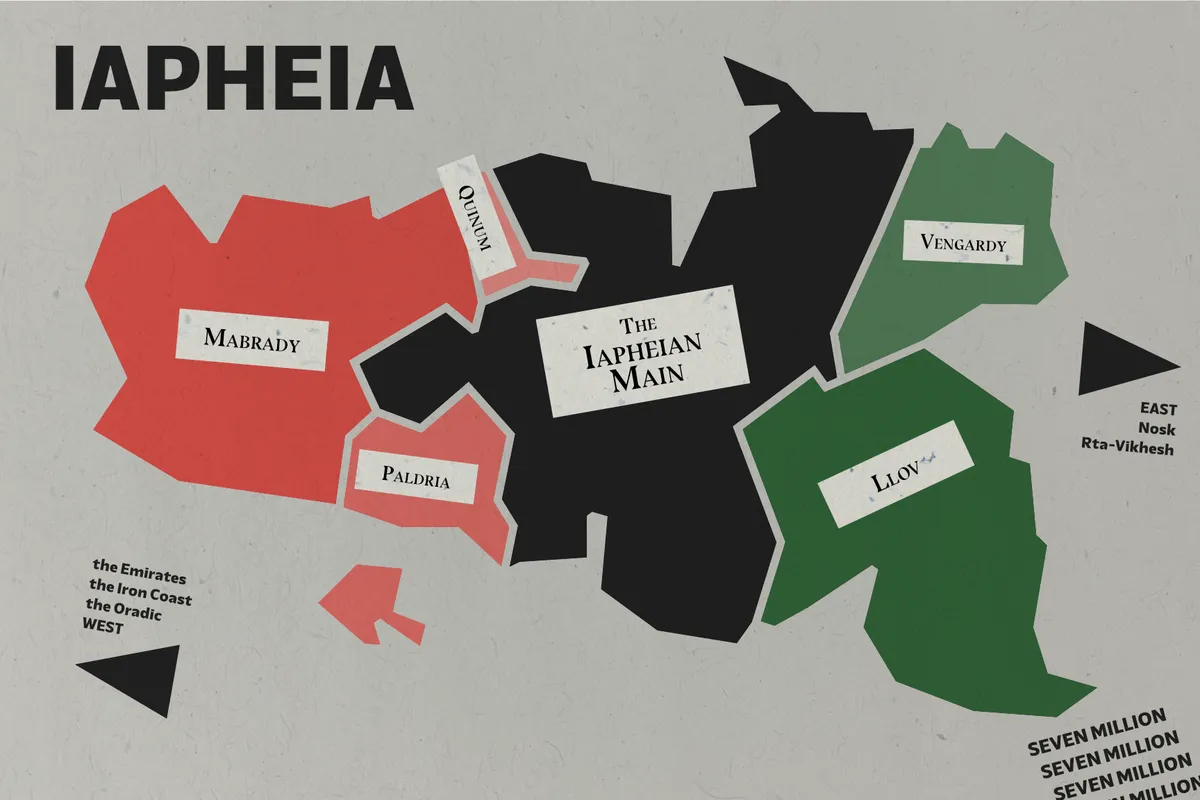
It's 1048, seven years after the Armistice. Iapheia's wounds bleed and fester, untreated.
Before the Tribulation War, the nations of Iapheia were bound together in countless subsets by a spiderweb of treaties, joint ventures, cultural and religious ties, and shared enemies. In fact, this web became so labyrinthine that even those responsible for it could no longer quite understand it, and risked transgressing centuries-old understandings with every uninformed step. The Ducal Theatre bombing was the flashpoint, but a trans-Iapheian war was probably inevitable within the next few years regardless, though the sides might have been completely different.
Regardless, there are only three groupings that matter in today's Iapheia: the Powers, the Remnants, and the Main.
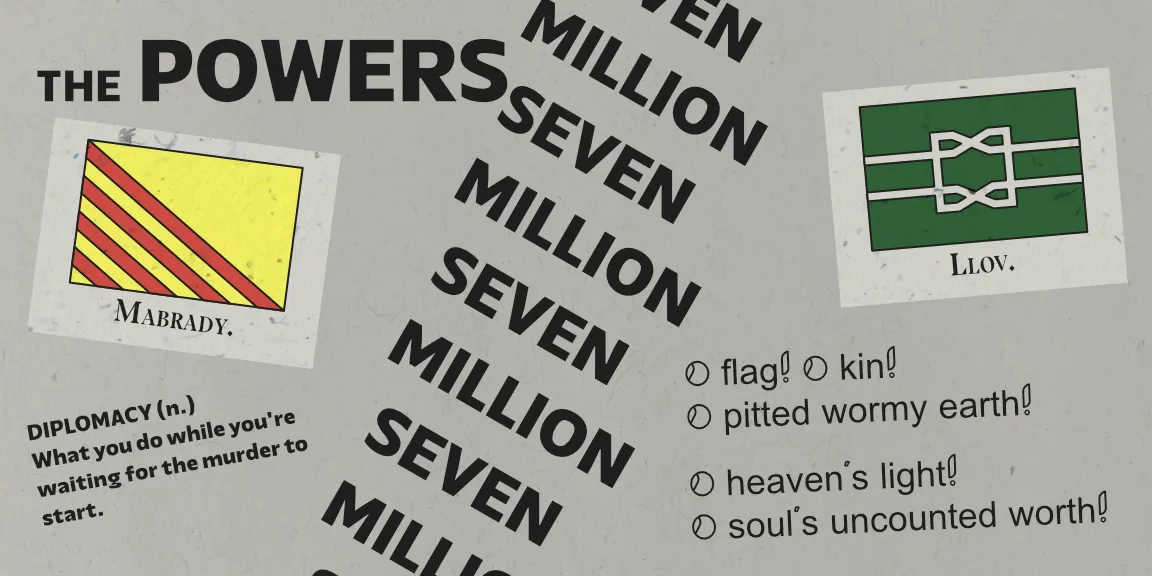
The prime architects of the Tribulation War are the only participants that survived it more or less intact.
To the average Mainer, the distinctions between the Powers have become meaningless. Their old home country sided with one or the other, but both committed ultraviolence and blasphemy in more or less equal measure, and both are seen as equally culpable for the aftermath.
Llov
The upstart, just over a hundred years old as a unified nation. Known for melodramatic internal history, fine cheeses, and dull but deafening orchestral music.
Proud, stubborn, and insecure about its relative youth, Llov's spate of heavy-handed "reclamation missions" in the 1010s and 1020s looks in hindsight like a warm-up for what was to come. The Tribulation War was Llov's first real military failure, and the public did not handle it well; the Armistice was followed by a "Red Year" of brutal militia riots that very nearly overthrew King Ceryv I.
Public order has now been restored and some regions have almost returned to pre-war living standards, but discontent continues to simmer. An increasingly popular belief is that Llov was thwarted not by exhaustion or attrition, but by divine displeasure, and a more moral society is the only thing that can restore it to glory. This idea has started to catch on among some of the power players at court, and is likely to go somewhere very ugly and very dangerous in the next decade or two.
Mabrady
The defending champion, the latest in a long line of formidable maritime states on Iapheia's western edge. Known for clinging smog, laconic wit (the kind that's not actually funny), and an eccentric, largely defunct aristocracy.
Mabradesc have a reputation for fatalism and a slightly embarrassing obsession with being the underdogs in any given conflict, however vast and obvious their material advantages. Mabrady was Iapheia's dominant power from the 950s through the 990s, thanks to its vast industrial base, which helped it endure the Continental Recession better than most. Accordingly, it entered the Tribulation War grim but determined, and left it merely grim.
Mabrady's senators and executors have done their best to brush off the war and forge ahead, pulling the nation's belt ever tighter and trying to ignore the middle-class exodus, the food riots, the ever-climbing suicide rate. Nobody says it aloud, but they all feel the need to conserve everything they can for the next war, whenever and wherever it's fought. The idea of another war on a comparable scale to the last one is too monstrous for many to contemplate, but the Mabradesc have always taken pride in expecting the worst.
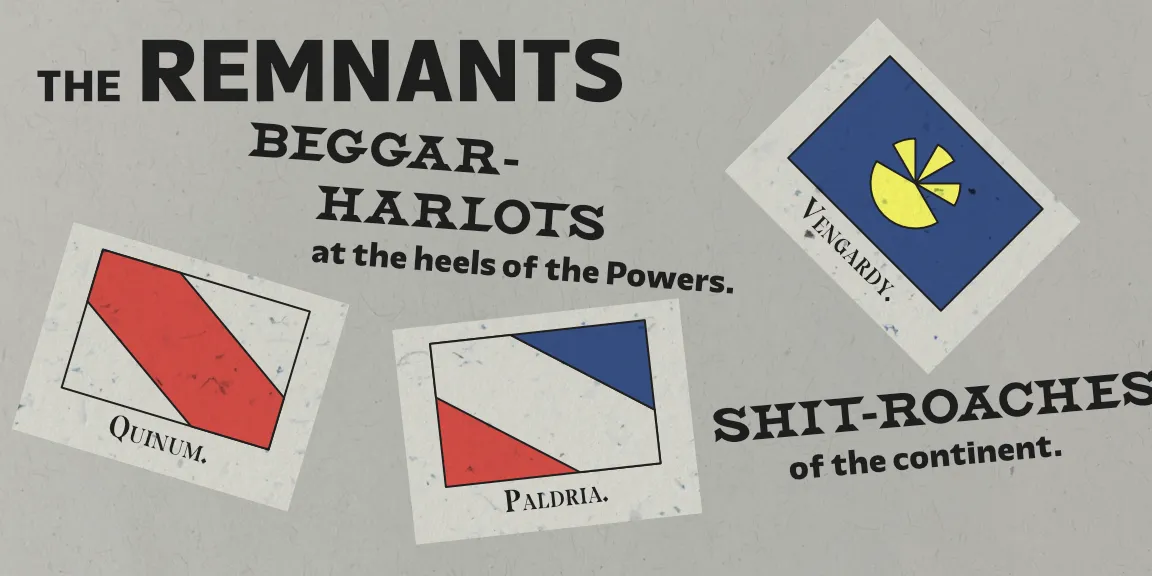
Among the Powers' allies, these few were spared the worst of the actual violence, at least within their borders. They still lost untold thousands, but their traumas are more social and psychic than physical.
Their influence is more keenly felt in the Main than that of the Powers, which have mostly pulled back to nurse their own wounds. They see opportunity in the chaos, and any opportunity, however dubious, is worth pursuing in such dismal times.
Vengardy
Known for excellent horses, dubious stews, and distinctly un-modesc gender norms. Vengardy once held hegemonic power over the half-dozen states that became Llov, and spent the whole 10th century trying and failing to cling to it.
After a couple of years of post-war chaos, the nation was rallied by a new elected Grand Duke: a blustering, unstable demagogue named Otho I who runs his government like a gentlemen's club. He asserts that Vengardy was "cuckolded" (he uses that word a lot) by its former allies / slaves to the south, and would have won the war had it been allowed to assert its full, thrusting, masculine virtue. His frequent razzias into the northeastern Main are scrappy, bumbling affairs, but, thanks to his legion of spin doctors, they are extremely popular.
Paldria
Known for vast cyclopean architecture, fine engineering, and being incredibly smug that they technically invented uranics. Paldria is an ancient state, one of the oldest on the continent, which has never quite found the power and glory its leaders feel it deserves.
Paldria was famously corrupt even before the Tribulation War, but a coup shortly before the Armistice cut out the middlemen (with actual knives, in some cases). The government has been fully usurped by organised crime, with centenarian mob patriarch Lumin Castori as Chancellor and several lesser families scheming beneath him. Age has not dulled Castori's ambition one bit, and the chaos of the Iapheian Main's surviving cities is fertile territory for his "gardeners"... assuming they can get there in one piece.
Quinum
Known for great universities, painfully unsubtle theatre, and rampant liver disease. Quinum has been conquered more than any other country on the continent, and is desperate for its neighbours to take it seriously.
Where many blamed the Powers for the Tribulation War, Quinans, spurred by a rich tradition of contrarianism, blamed the system that let the Powers arise and made Iapheian politics so complicated. Quinum technically no longer exists as a state, but as a "league of voluntary communities", a sort of proto-anarchosyndicalism. The old hierarchies have been abolished and replaced with new, less visible ones based on social clout and status games. It's very easy to get yourself exiled from Quinum if you piss off the wrong Speaker or Comrade-Coordinator, and most of these exiles are shoved across the border (they claim they don't have one, but they obviously do) into the Iapheian Main.
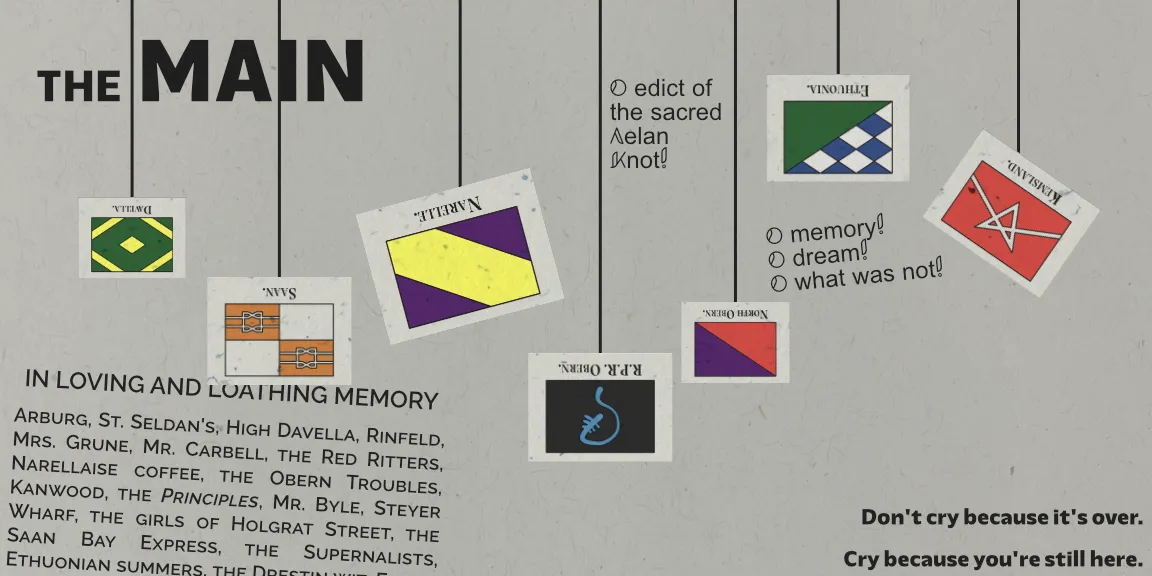
The nations sandwiched between Llov and Vengardy in the east and the Mabradesc axis in the west were once called the Meridian States. Though a couple were individually powerful and influential in centuries past, they were bit players in the great Iapheian tragedy. They were, however, the artistic, cultural, and philosophical centre of the continent. Llov's art and thought were too much in thrall to the past, and Mabrady's social elites had always been far more interested in the concrete than the abstract, but the Meridian States were a melting pot of innovation and dialogue.
The land remains, the people remain, some of the cities remain, but the countries, the governments, the identities, are dead. Of course, memories die hard, and some still call themselves Kemsan or Narellaise or what have you, but it's an affectation.
The city is a far more important institution now than the country, and deserves its own post, but, for context's sake, here are some of the names and attainments of the lost.
Narelle was the mercantile heart of old Iapheia, its power fading with the tides of the modern market it had helped shape. The majestic port capital of Comiresse, levelled in 1037 by Llovan artillery, was the traditional centre of the continent. The Narellaise government fled inland to Vonte, and is actually still around, but its authority carries no further than its crumbling "temporary" chambers.
Davella, once Narelle's "second city", grew through the 8th and 9th centuries into an industrial monstrosity and the largest city in the known world, and seceded in 925 following a short civil war. It became a sort of landlocked pirate republic, a haven for the strange, scandalous, and revolutionary, and a crucible for transgressive art. About half of Davella still stands. (I'm thinking of using Davella as a sort of central hub city for my campaign region, albeit not the starting city.)
North Obern was home to both the finest liturgical music and the finest bordellos and cathouses on the continent. Its dour, devout southern sibling, the Reformed Pietran Republic of Obern, was instead a scientific powerhouse, and its universities and ateliers achieved many of the breakthroughs that enabled the horrors of modern warfare.
Kemsland was the cauldron of modern democracy, the first nation to fully replace its king - peacefully, no less - with an elected assembly. It was a wet, dismal land, but its authors produced magnificent farces and satires, and its sweet wines and brandies were the stuff of legends.
Ethuonia was the trendsetter of Iapheia, where artists, thinkers, and pompous gadabouts of every nation came together to decide, week by week, what was and was not modesc. The resultant polemic pamphlets, rallies, and duels were sometimes sporting, sometimes venomous, but always entertaining.
Saan was always the odd duck among the Meridian States, a large, poor, mostly agrarian realm whose two distinctions were a thriving drugs trade and a vast natural supply of zinc, an essential component in many uranic devices. In 1031, it gained a third: in Saanlat, at the Ducal Theatre, the bomb was detonated that would ultimately begin the Tribulation War.
That's not even all of them. Don't forget Mucennes, Gyron, Lugudia, the Harvender League, or the Free Pietran Cities. Or perhaps do forget them, and find new names to live and die for.
A future post will detail some of the lands beyond Iapheia.